Day 10 of 30 — 30 Days of Stoicism series
Imagine yourself rising.
Not metaphorically, physically.
You’re sitting where you are right now.
Then you’re floating above yourself, looking down at the room.
Then above the building.
Above your neighbourhood.
Above your city, visible now as a grid of roads and lights and rooftops.
Above your country.
Above the continent.
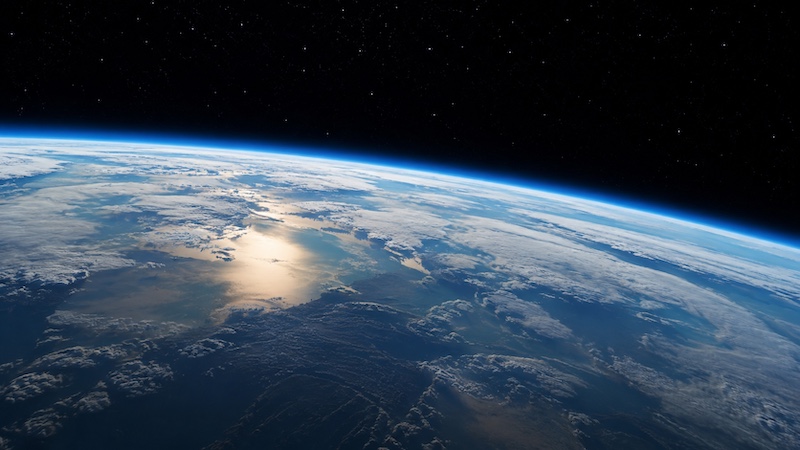
Above the planet, a small blue sphere, tilted at its particular angle, turning slowly in the dark.
Look at it from there.
Now find, on that sphere, the exact coordinates of whatever is worrying you today.
This is the Stoic exercise Marcus Aurelius called the view from above.
He used it to shrink the apparent scale of his anxieties, not by dismissing them, by putting them in a context that made their real size visible.
“Think not of the things which are not, but of those which are, and of those which are, select the most important.”
— Marcus Aurelius
From orbit, most of what feels urgent becomes harder to locate.
The exercise sounds almost comically simple.
The people who practise it consistently report something real: the perspective shift isn’t just cognitive, it’s felt.
Something changes in the body when you hold your problems against the background of actual scale.
Not a dismissal, the problems are still there, still real, still yours to deal with.
They are differently sized.
Differently weighted.
Marcus used the view from above particularly around reputation, the obsession with what other people thought of him, the fear of being judged, the desire to be admired.
From the surface of the earth, what people in Rome thought of the Emperor felt enormous.
From beyond the atmosphere, it was harder to locate.
“What is the empire of Rome,” he wrote, thinking of Alexander the Great, “and what beyond it? All small things.”
This might be the most practically applicable Stoic exercise for modern life.
We live inside information environments specifically designed to make everything feel maximally urgent and maximally personal.
Every outrage, every slight, every failure, every bad take, the architecture of the attention economy feeds us these things in formats designed to keep us close and reactive.
The view from above is, in that context, almost a countercultural act.
A refusal to live at the scale that the algorithm prefers.
For vegans, this exercise is double-edged, and worth being honest about that.
On one edge: the view from above helps with the particular grief of caring about animal use at scale.
The numbers are staggering, billions of land animals killed for food each year, marine ecosystems collapsing, generations of creatures born into systems designed to use and discard them.
Holding that at full emotional weight, all the time, is not sustainable.
The view from above doesn’t make those numbers smaller
Though it does change your relationship to them, from a weight you’re crushing under to a context you’re working within.
On the other edge: veganism is, in part, a refusal of the view from above as a coping mechanism.
It’s a choice to stay close, to not look away, to not comfort yourself with abstraction, to keep the individual animal visible rather than dissolving them into statistics.
The view from above is useful for managing your own anxiety.
It shouldn’t become a reason to stop caring about the scale.
The discipline is in knowing when to use it.
When you’re close to burnout, close to despair, close to the kind of rage that consumes without producing, rise.
Get the scale right.
Remember that you are one person in a long movement with a long history, doing what is yours to do.
And when you’re tempted to look away, to file things under “too big to think about,” to find comfort in the idea that nothing you do matters anyway, come back down.
The animal is still there.
The choice is still yours.
Practice for today
Sit quietly for five minutes.
Visualise rising, slowly, in stage, to the edge of the atmosphere and beyond.
Look back.
Find your current stress or worry on the surface of that planet.
Then write one sentence, just one, describing your situation from that vantage point.
Notice whether the sentence sounds different from the one you’d have written before the exercise.

Cameron Blewett has been vegan for thirty years. He spent over a decade living by Stoic principles before he found out that’s what they were called.
He writes about food safety, vegan ethics, and the overlap between Stoic philosophy and plant-based living, work that doesn’t fit the modern secular Stoic mould, and isn’t trying to.
Based in Melbourne, Australia, he also writes at CameronBlewett.blog, greybeardedvegan.blog and foodsafety.ist.