Day 19 of 30 — 30 Days of Stoicism series
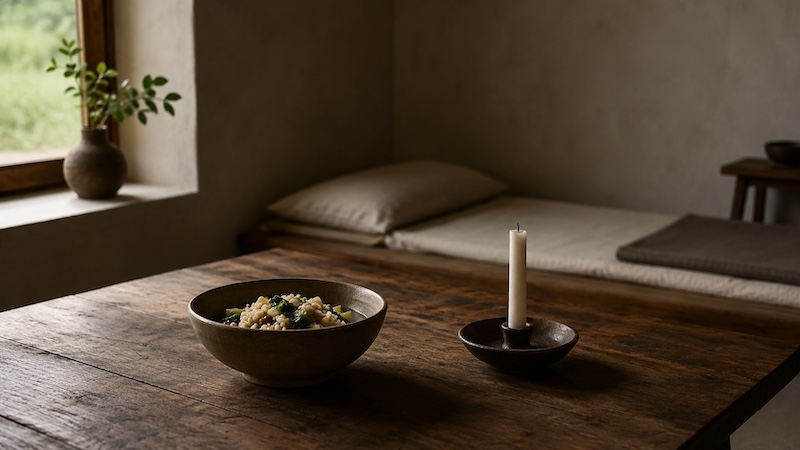
Once a month, Seneca slept on a hard surface, wore minimal clothing, and ate the plainest food available.
This wasn’t from necessity.
He wanted to find out what it felt like to have less, and to prove to himself he could handle it.
“I am not trying to be a tough guy. I am trying to find out how much Fate would have to take from me before it could take anything from me — that is, I am trying to find out how little Nature requires.”
~ Seneca
That’s the point of voluntary discomfort.
Not suffering for its own sake.
Not a performance of virtue.
The deliberate removal, for a limited time, of something you’ve come to rely on, to discover you can live without it and loosen the grip comfort has over your choices.
The Stoics identified comfort as one of the primary mechanisms by which external circumstances come to own you.
When your happiness depends on a hot shower, a particular food, a certain level of physical ease, the threat to any of those things becomes a threat to your equilibrium.
You make decisions to protect your comfort that you wouldn’t make if you were indifferent to it.
You avoid situations, conversations, and choices that might disturb it.
You become, without quite noticing, governed by the thing you’re trying to enjoy.
Voluntary discomfort is training for indifference, the real thing rather than its performance.
The practice of choosing, occasionally, to do without something you prefer, so the preference stays a preference rather than becoming a dependency.
Marcus Aurelius practised versions of this throughout his reign.
Despite having access to every luxury the Roman world offered, he reportedly slept on a simple military mattress, ate simply, and routinely chose austerity over comfort when he had the choice.
Not as martyrdom.
As practice.
Epictetus, as a former slave, had a different relationship to this.
He’d had involuntary discomfort as the basic condition of his life.
What he emphasised was the inner freedom that comes from genuinely not needing what you don’t have: the discovery, through experience, that the bare minimum is often enough, and everything above it is pleasant without being necessary.
For vegans, voluntary discomfort has an interesting resonance.
In one sense, the choice to go vegan is already a form of voluntary discomfort.
You’ve removed from your life a large category of foods that most people around you eat freely.
You’ve taken on the inconvenience of reading labels, of navigating menus, of explaining your choices repeatedly, of living in a food system that wasn’t designed for you.
That is real discomfort, voluntarily chosen, for principled reasons.
The Stoic practice takes this further, in the general direction of noticing what else you’re relying on, beyond food.
What other comforts have become dependencies?
What are you currently unwilling to do without that you could, in fact, do without?
The aim isn’t to make life harder.
It’s to find where “I enjoy this” has crossed into “I need this to be okay.”
That crossing is where comfort becomes a vulnerability.
The practice for this week is to choose one thing (not a dramatic deprivation, just one thing) and voluntarily give it up for a set period.
A hot shower.
A particular food.
Scrolling before bed.
The comfortable chair.
Something you reach for automatically, without thinking.
Then sit with the absence.
Don’t immediately replace it.
Don’t distract yourself from the mild discomfort of not having it.
Just notice what comes up.
What usually comes up, for people who do this honestly, is surprise.
Surprise at how quickly the discomfort passes.
Surprise at how little the thing was actually contributing to their wellbeing.
Surprise at what remains when it’s gone, often more than they expected.
Seneca called this inoculation.
A small, controlled dose of difficulty makes you more resistant to larger, uncontrolled doses.
The person who has voluntarily gone without something they value is less destabilised when that thing is taken from them by circumstances.
The muscle was already developed.
The capacity was already there.
“Set aside a certain number of days, during which you shall be content with the scantiest and cheapest fare, with coarse and rough dress, saying to yourself the while: ‘Is this the condition that I feared?'”
~ Seneca
Usually, the answer is no.
Practice for today
Choose one comfort to voluntarily remove for three days, something real, not something trivial.
Sit with the discomfort without immediately resolving it.
Write at the end of each day: what did this reveal about what you actually need, versus what you’ve come to expect?

Cameron Blewett has been vegan for thirty years. He spent over a decade living by Stoic principles before he found out that’s what they were called.
He writes about food safety, vegan ethics, and the overlap between Stoic philosophy and plant-based living, work that doesn’t fit the modern secular Stoic mould, and isn’t trying to.
Based in Melbourne, Australia, he also writes at CameronBlewett.blog, greybeardedvegan.blog and foodsafety.ist.